

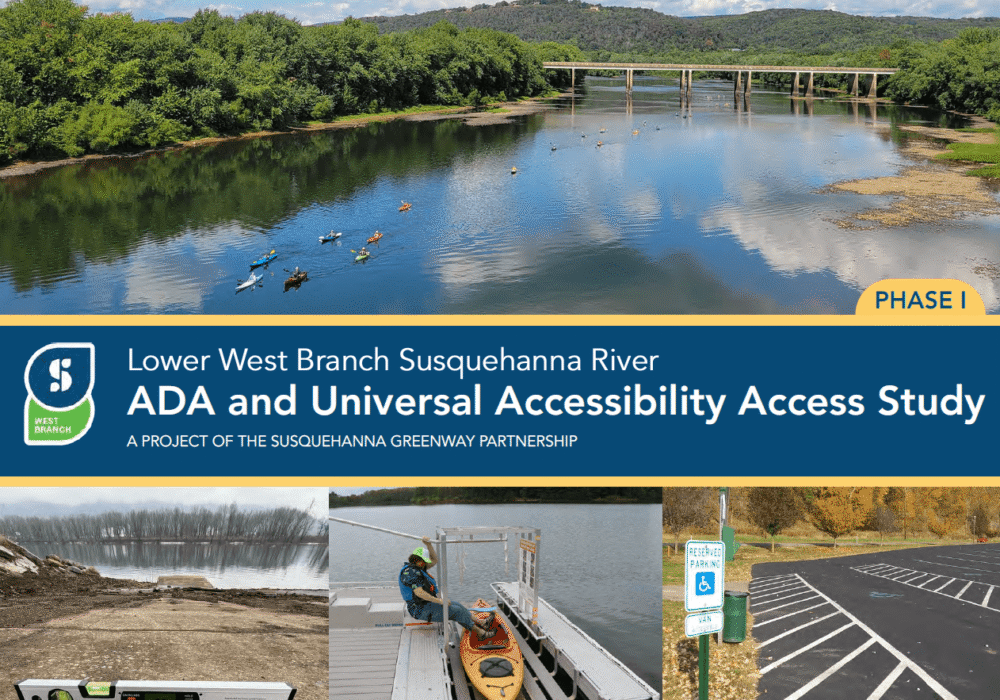
Study provides a new framework for evaluating accessibility at river access sites and a roadmap for improvements from Renovo to the Susquehanna River confluence at Northumberland.
The Susquehanna Greenway Partnership (SGP) has completed a comprehensive accessibility study of river access sites along the Lower West Branch of the Susquehanna River, creating a new framework that can help communities and access owners improve accessibility for people of all abilities.
The study, which examines access sites from Renovo downriver to the confluence of the West and North Branches at Northumberland, addresses a challenge that has received little attention in Pennsylvania: there was no existing template for evaluating the ADA and universal accessibility of river access sites. While a small number of models exist elsewhere in the country, there is no widely established standard for assessing accessibility across Pennsylvania’s river access network.
“River access is a little different from a traditional park or trailhead,” said Alana Jajko, Executive Director of the Susquehanna Greenway Partnership. You can’t apply the same standards you would use for a sidewalk or parking lot to the launch itself since the angle and design of a boat launch must meet certain criteria to accommodate paddlers and watercraft. What we can evaluate—and what can make a tremendous difference—is everything that gets a person from their vehicle to the river.”
Looking Beyond the Launch
The study recognizes that a river launch itself cannot necessarily be considered fully accessible without specialized infrastructure, such as an accessible kayak or canoe launch dock. Rather than treating accessibility as an all-or-nothing designation, SGP’s approach evaluates the elements that can be improved to move a site toward greater ADA compliance and universal accessibility.
The assessment considers:
- Accessible parking, including location, dimensions and connections to other site features;
- Accessible routes and paths between parking, amenities and the river;
- Restrooms (to the door) and other amenities;
- Signage and wayfinding;
- Site circulation and potential barriers; and
- The connection between these features and the river access point itself.
By evaluating the entire experience—not just the boat launch—the study provides access owners with practical opportunities to make their sites more welcoming and usable.
A Roadmap for Each Access Site
The study includes a recommended action plan for every site evaluated, identifying opportunities for improvements, and providing access owners with a practical starting point for future projects.
As part of the process, SGP met individually with every access owner in the study area to review the findings and discuss potential improvements. This direct engagement was an important component of the project, helping ensure that the recommendations are useful and realistic for the communities and organizations responsible for maintaining these sites.
“Accessibility improvements don’t have to happen all at once,” said Jajko. “There are meaningful steps that communities can take—from improving parking and creating a continuous accessible path to upgrading amenities—that can make a river access site more usable while working toward larger improvements in the future.”
A Model for the Susquehanna River Water Trail and Beyond
While the study focuses on the Lower West Branch, its potential application extends far beyond the project area. SGP intends for the assessment process, surveys, tools and resources developed through the project to serve as a model for future accessibility studies throughout the Susquehanna River Water Trail and at other river access sites.
The complete study, including the assessment tools, surveys, resources and site-specific recommendations, is available at this link.
The project supports SGP’s broader goal of improving outdoor recreation access throughout the Susquehanna Greenway and helping more people walk, bike and paddle their way through the region.
This study was financed in part by a grant from the Community Conservation Partnerships Program, using Environmental Stewardship Funding, under the administration of the Pennsylvania Department of Conservation and Natural Resources, Bureau of Recreation and Conservation. Project components were also supported by grants from the Susquehanna River Basin Commission and the Pennsylvania Organization for Watersheds & Rivers.

About the Susquehanna Greenway Partnership
The Susquehanna Greenway Partnership (SGP) is a nonprofit organization working to connect people, communities and outdoor recreation opportunities throughout the Susquehanna Greenway. SGP serves as Pennsylvania’s water trail manager for the West Branch Susquehanna River Water Trail and works with communities and partners to improve access to trails, waterways and outdoor recreation throughout the Susquehanna River corridor.
Learn More About SGP